Stop CPA Australia forcing its members to support DEI!
The Case
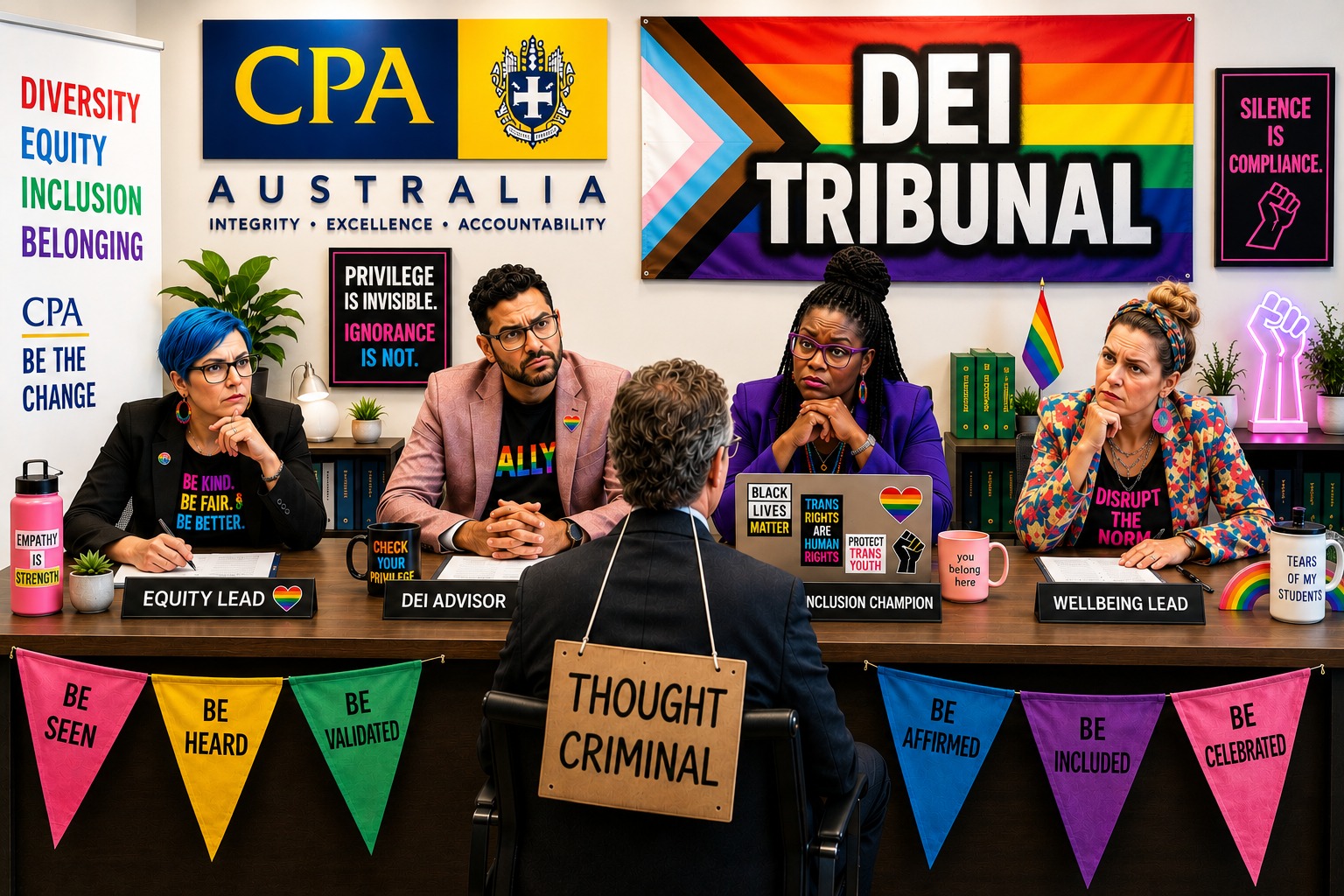
A FSU member is being prosecuted for what he said in a meeting his own professional body asked him to speak in. David Hardidge, a senior elected office-holder in the Queensland Divisional Council for CPA Australia, is facing internal disciplinary proceedings, and now a Disciplinary Tribunal hearing, over comments he made during a formal committee discussion.
The subject of that discussion? A so-called diversity and "belonging" policy that the association itself had put on the agenda and asked its councillors to debate. The policy commitment was that everyone is empowered to be their authentic self and all people feel safe to express themselves authentically.
David did exactly what he was required to do. After allowing all other councillors present to give their view, he gave his honest view. He questioned parts of the policy, raised concerns members had brought to him, and pushed back on aspects he thought were flawed.
Little did he know that only certain positions were allowed and this was never supposed to be a genuine discussion. David is now being pursued by CPA Australia under the profession's ethics code, accused of letting "personal bias" compromise his professional judgment, for expressing a view in a debate.
This is staggering. A professional body invites its members to discuss a policy, and then prosecutes one of them because they did not like the answer he gave.
The process itself shows the unfairness.Throughout this matter David has faced:
- A complaint that alleges he “allowed his professional or business judgment to be compromised by bias”, and that he “acted in a manner inconsistent with the profession’s responsibility to act in the public interest”.
- Correspondence from the body that appeared to pre-judge the outcome before he had even responded.
- Pressure to the effect that the airing of his views, and any further attempts to do so, would be bad for his career.
These are not the hallmarks of a fair process. They are the marks of an outcome decided in advance, with the procedure bolted on afterwards.
If a professional body can prosecute a member for contributing to a debate it convened, and public commitment for inclusion, then no member is safe. Every councillor, every office-holder, every professional who has ever been asked for their honest opinion learns the real lesson: say what the leadership wants to hear, or face formal investigation and punishment.
If this approach is applied by your professional body, it will mean that you will be required to follow whatever ideological or contentious social policy that organisation decides, in order for you to work in your profession.
The Free Speech Union exists to make sure people are not left to face this alone. Our strength is our numbers, and right now David needs those numbers behind him. Please support David today or become a member.
Support David
Join Us
Become a member of the Free Speech Union and help protect freedom of expression in Australia.
Become a MemberFrequently Asked Questions
All donations will be paid towards David’s legal expenses, unless there is an excess of donated funds, in which case the money will be used by the Free Speech Union of Australia to support other people like this member.
.You can get in touch by completing our contact form. All communications will be treated as being in confidence.
.This is a private disciplinary hearing so it won't be available to be viewed by the public! If things don't go in David's favour, future proceedings might be available to the public. We find the lack of open justice troubling.
.1. The reach of professional ethics codes into personal opinion.
The central question is whether a professional conduct code, intended to protect the public and govern public facing or commercial interactions, can be stretched to police a member’s opinions or social political questions, especially internally. CPA Queensland says it is not disciplining David for his views, only for the “manner” in which he expressed them in a governance setting. But when the substance of the complaint is that his contribution did not align with the organisation’s preferred pro DEI position, that starts to look like an artificial distinction.2. Natural Justice and Procedural Fairness.
Disciplinary processes are bound by basic fairness: a person must know the case against them, must have a genuine chance to respond, and must be judged by a body that has not already made up its mind. David has received a complaint that does not clearly particularise what was actually breached, correspondence that reads as pre-judging the outcome, and difficulties in obtaining proper representation.
3. Anti-Discrimination Law.
Queensland anti-discrimination law makes it a live and contested question as to whether a political belief or activity such as the views expressed by the member are unlawful discrimination for the purposes of the Anti-discrimination Act 1991 (Qld). Under the Act, discrimination on this ground is unlawful regardless of whether or not the opinion or belief discriminated against is genuinely held by the person who is the subject of unlawful action.